How AI Skin Analysis Works: Computer Vision Explained
Take a look at your phone. Most of us use the camera for selfies or quick snaps of our lunch. When you use an AI skin scan, it feels like magic. You take a photo, wait a few seconds, and suddenly you have a detailed report on your pores, wrinkles, and hydration levels. It seems like the app is just glancing at your face and making a guess.
In reality, there is a complex dance of mathematics and biology happening behind the screen. Your phone is not seeing a face the way a human does. It is seeing a massive grid of numbers. Every tiny dot of color is a data point. The AI takes that simple selfie and transforms it into a highly detailed map of skin health.
This process is called computer vision. It is the same technology that helps self driving cars spot a stop sign or allows your phone to recognize your face to unlock the screen. In skincare, this technology is trained to spot the subtle differences between a freckle and a dark spot. It looks for patterns in texture and tone that are often invisible to the naked eye.
Dermatologists agree that consistency is key to skin health. However, it is hard to track progress when you look in the mirror every single day. You might not notice a fine line forming or a slight shift in redness until weeks later. AI analysis removes the guesswork. It provides an objective baseline so you can see if your routine is actually working.
It is a bridge between the art of skincare and the precision of data. By turning visual information into actionable insights, the technology helps you understand what your skin actually needs. It moves the conversation away from generic trends and toward personalized care.
It all begins with a single image.
From Pixels to Pores: The Big Picture
To the naked eye, a selfie is just a photo. It is a collection of memories or a quick check to see if your hair is behaving. But to an AI, that photo is actually a massive grid of numbers. Every single tiny square of color, known as a pixel, carries specific data about light, hue, and intensity.
The magic happens when the app stops seeing a face and starts seeing patterns. It treats your skin like a map. By analyzing these pixels, the AI can spot things that might be invisible to you in the mirror. It looks for clusters of redness that suggest inflammation. It identifies the specific contrast of dark spots against your natural skin tone. It even measures the depth of a fine line by tracking how shadows fall across the surface of your skin.
Basically, the app converts visual information into data points. It is similar to how a digital scale turns pressure into a number. Instead of weight, the AI is measuring texture, tone, and pore density. This process allows the technology to categorize skin conditions with a level of precision that feels almost superhuman. If you want a deeper dive into the basics of this technology, check out our guide on AI skincare 101.
This transformation relies on computer vision, which gives the app its ability to see.
Computer Vision: The 'Eyes' of the AI
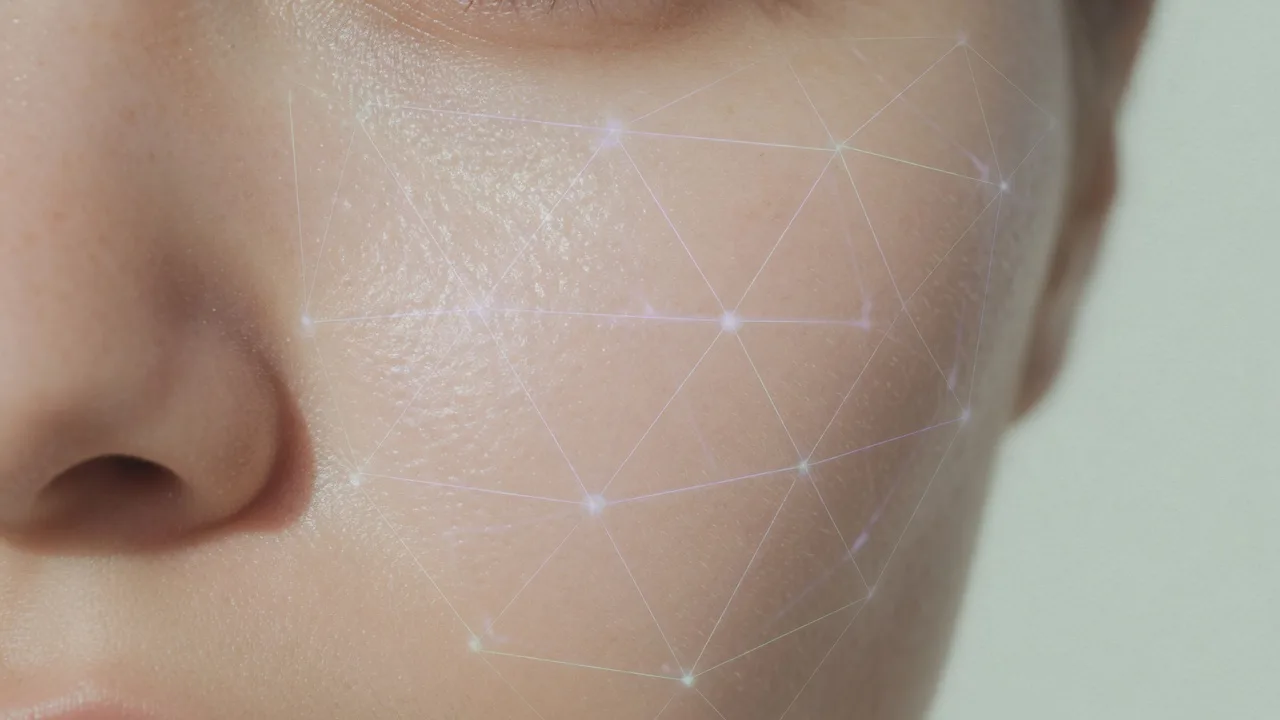
Think of computer vision as the way a machine translates a photo into a language it can actually understand. When you look in the mirror, you see your face. When an AI looks at a photo, it sees a massive grid of numbers representing pixels. It is essentially a high speed game of Connect the Dots.
The process starts with the basics. The AI looks for edges and contrast. It identifies where a dark line meets a light area to map out the contours of the skin. Once the basic shape is set, the AI dives into the details of color and texture. It scans for specific hues of red to spot inflammation or rosacea. It looks for tiny shifts in shadow and depth to find fine lines and wrinkles that might be invisible to the naked eye.
This is where the magic of the /blog/ai-skin-analysis-revolution really happens. The technology can pick up on subtle patterns that a human might miss. It analyzes the way light hits the surface of the skin to determine if it is dry or hydrated. It checks for clusters of dark pixels to identify sunspots or hyperpigmentation. By breaking the image down into these tiny components, the AI creates a digital map of the skin's current state.
It is a lot like how we learn to recognize a face. We do not just see a person. We see the curve of a jawline or the color of an eye. The AI does the same thing with skin health. It recognizes that a certain shade of pink in a specific pattern usually means redness. It knows that a series of parallel lines in a certain area indicates a wrinkle.
Of course, seeing the patterns is only the beginning. Interpreting what they mean requires a deeper layer of intelligence, powered by machine learning.
Machine Learning: The 'Brain' Behind the Analysis
Think of machine learning as a massive, digital library. This isn't your average neighborhood library with a few thousand books. This is a global archive containing millions of high resolution images of every skin type, tone, and condition imaginable. Each image is a verified clinical example. They are labeled by experts to ensure the AI knows exactly what it is looking at.
When a user uploads a photo, the AI doesn't just guess based on a hunch. It rushes into this library to find a match. It takes the patterns it found in the photo and compares them against those millions of clinical images. It looks for similarities in texture, color, and distribution. If the system sees a specific type of redness, it scans the archive for every single instance of that redness. It asks itself if this looks more like a temporary flush or a chronic condition.
This process happens in milliseconds. The AI is essentially playing a high speed game of "spot the difference" across a dataset that would take a human lifetime to read. The more images the system sees, the smarter it gets. This is why clinical validation is so important. The quality of the library determines the quality of the answer. If the AI has only seen one type of skin, it will struggle with others. By training on a diverse range of verified data, the system becomes an expert in nuance.
The result is an analysis based on evidence rather than a generic algorithm. The AI isn't just following a simple checklist. It is recognizing complex visual signatures that have been confirmed by dermatologists. It connects the dots between a few pixels on a screen and a real world skin concern.
With the analysis complete, the system moves from recognition to reporting. Behind every accurate report is a sequence of processing steps that happen in milliseconds.
The Step-by-Step Journey of Your Selfie
The moment you hit that shutter button, your selfie begins a high speed trip through a digital pipeline. It happens in milliseconds, but there is a lot of heavy lifting going on behind the scenes. The first stop is image preprocessing. Let's face it, we rarely take our skin photos in a professional studio. Most of us are in a bathroom with flickering fluorescent lights or leaning toward a window for a bit of sun. The AI starts by cleaning up the noise. It corrects the lighting and balances the colors so that a shadow under the nose isn't mistaken for a dark spot. This ensures the analysis is based on your actual skin and not just a bad light bulb.
Once the image is polished, the AI moves into facial mapping. It doesn't just see a face as one big canvas. Instead, it divides your skin into specific zones. It identifies the T zone, the cheeks, and the jawline. This is crucial because skin behaves differently depending on where it is. Your forehead might be oily while your cheeks are bone dry. By mapping the face, the system can apply different rules to different areas. This level of detail is what helps you get a better handle on /blog/understanding-skin-health.
Finally, we hit the feature extraction phase. This is where the AI gets really picky. It scans those mapped zones for specific patterns. It looks for the contrast of a pore, the depth of a fine line, or the redness of a breakout. It is essentially translating your skin into a mathematical language of pixels and gradients.
The process looks like this:
- Lighting correction to remove shadows and glares.
- Zonal mapping to separate the forehead, cheeks, and chin.
- Feature extraction to pinpoint specific skin concerns.
By the time this process finishes, your selfie is no longer just a photo. It is a detailed map of data points. The system now knows exactly where your skin is thriving and where it needs extra attention. But what specific markers is it actually detecting?
What Exactly is the AI Looking For?
To a computer, your face is basically a giant puzzle made of pixels. It doesn't see a "pore" the way a human does. Instead, it looks for patterns in color, contrast, and texture. It is searching for specific markers that signal what is happening beneath the surface of the skin.
Take sebum levels, for example. The AI looks for how light bounces off your forehead or nose. Oily skin reflects light in a very specific, specular way. It creates "hot spots" of brightness that the system recognizes as excess oil. On the flip side, dry skin scatters light. It looks matte or flaky. By analyzing these light patterns, the AI can tell if your skin is overproducing oil or screaming for a moisturizer.
Then there is the challenge of pigment. The system scans for clusters of pixels that are darker than the surrounding skin tone. It distinguishes between a temporary blemish and deep seated hyperpigmentation by looking at the edges and the depth of the color. A shadow has a soft gradient. A dark spot has a distinct boundary. This allows the AI to map out sun damage or acne scars without needing a magnifying glass.
Barrier health is a bit more subtle. The AI looks for signs of inflammation and texture irregularity. It scans for redness in the cheeks or a rough, uneven surface that suggests a compromised skin barrier. When the skin is healthy, the texture is smooth and the tone is consistent. When the barrier is struggling, the pixels show a chaotic pattern of irritation and dehydration.
It is essentially a high speed game of "spot the difference." The AI compares your photo to millions of other images to find these markers. It identifies:
- The depth and angle of fine lines to separate them from natural skin folds.
- The distribution of redness to identify sensitivity.
- The density of pores in the T zone.
Precision, however, depends on the breadth of its training. Without diverse examples, even the best algorithm falls short.
The Importance of Diverse Data Sets
Imagine an AI that was trained exclusively on fair skin. It would be an expert at spotting a tiny red flush or a light brown freckle. But when it encounters deeper skin tones, it might completely miss a sign of inflammation or misread a dark spot as something else entirely. This is where algorithmic bias creeps in. If the data used to teach the AI is narrow, the results will be narrow too.
True inclusivity in skin tech is not just a nice to have. It is a necessity. Skin behaves differently across various ethnicities. For example, hyperpigmentation often manifests differently on deeper skin tones than it does on lighter ones. Without a massive, diverse library of images, an AI cannot tell the difference between a natural skin variation and a concern that needs attention. This is why having a wide spectrum of training data is so vital. It ensures that the technology provides accurate insights for everyone, regardless of their heritage.
Age is another huge factor. The skin of a twenty year old is a completely different canvas than the skin of a seventy year old. Texture, elasticity, and pore size all shift over time. An AI needs to see thousands of examples from every decade of life to understand what is a normal part of aging and what is an actual skin concern.
To get this right, developers focus on a few key areas:
- A wide range of Fitzpatrick skin types to ensure accuracy across all tones.
- Images from different age groups to account for natural aging processes.
- Photos taken in various lighting conditions to prevent shadows from being read as blemishes.
- Diverse gender representation to account for hormonal differences in skin.
When an AI is trained on a truly global data set, it becomes a tool for empowerment. It allows people to find the right skincare for skin of color guide and personalized routines that actually work for their specific biology. The goal is a system that sees everyone clearly.
With a comprehensive data set, the AI can provide accurate insights. But there's a crucial line between insight and diagnosis that must be understood.
Insight vs. Diagnosis: Knowing the Difference
Here is the truth about AI skin analysis: it is a powerful tool, but it is not a doctor. When an app tells you that your skin shows signs of dehydration or a few new fine lines, it is providing an insight. This is data driven. The AI is simply comparing your pixels to thousands of other images to find a pattern. It is like having a very smart mirror that can spot things the human eye might miss.
A diagnosis is something entirely different. That requires clinical judgment. A dermatologist does not just look at a photo. They look at your medical history. They feel the texture of your skin. They ask about your lifestyle and your genetics. They use years of medical school and hands on experience to determine exactly what is happening under the surface.
Think of it as a partnership rather than a competition. AI provides the "what" and the dermatologist provides the "why." An AI analysis can act as a red flag. It might notice a change in a mole or a sudden flare up of redness that you had not seen yet. This gives you the perfect starting point for a medical visit. Instead of saying "my skin feels weird," you can show your doctor the data and ask specific questions. This makes the appointment much more efficient.
If you are wondering more about how these two roles interact, check out the breakdown of AI skin analysis vs dermatologist.
The goal is not to replace the expert. The goal is to give you a better map of your own skin so you can have a more productive conversation with your provider. When you combine the precision of computer vision with the wisdom of a clinician, you get the best possible care.
With that clarity, the next step becomes possible: turning data into a truly personalized skincare plan.
Unlocking Hyper-Personalization
For a long time, getting a truly professional skin classification was a luxury. You had to book an appointment at a high end clinic and hope the specialist had a keen eye for the subtle nuances of your complexion. Most of us just settled for the basic categories. We called ourselves oily or dry and hoped for the best. But the truth is that skin is far more complex than four simple categories.
That is where AI changes the game. By using computer vision, the technology can identify patterns that the human eye might miss. This allows for the implementation of advanced frameworks like the Baumann skin types. Instead of a broad label, this system breaks skin down into 16 distinct types. It looks at whether your skin is oily or dry, sensitive or resistant, and pigmented or non pigmented.
When you combine these factors, you get a map of your skin that is incredibly precise. It explains why a product that worked for a friend might cause a breakout for you. It turns out you aren't just oily. You might be Oily Sensitive, which requires a completely different approach than someone who is Oily Resistant.
This level of detail is the foundation of hyper personalization. Once the AI identifies your specific type, the guesswork disappears. You no longer have to spend money on a dozen different serums just to see what sticks. Instead, you can use tailored skincare routine generators to find ingredients that actually align with your biological needs. Dermatologists agree that using the wrong active ingredient can do more harm than good. Precise classification ensures you are supporting your skin barrier rather than stripping it away.
It is essentially like having a clinic grade consultation in the palm of your hand. You get the accuracy of a professional analysis without the waiting room. This shift moves skincare from a game of trial and error to a precise science.
Ultimately, all this technology serves one simple purpose.
The Bottom Line
At the end of the day, all this talk of neural networks and computer vision can feel like a lot. It sounds like science fiction. But the actual goal is much simpler than the tech behind it. It is all about removing the guesswork from your skincare routine.
We have all been there. You spend forty dollars on a serum because a popular influencer swore by it, only to find out it makes your skin break out or does absolutely nothing at all. Skincare often feels like a game of trial and error. You guess what your skin needs, hope for the best, and wait weeks to see if it actually works. That is a lot of wasted time and money.
AI skin analysis changes that dynamic. Instead of guessing, you get a clear picture of what is actually happening beneath the surface. It turns those invisible concerns into visible data. This means you can stop treating your skin based on a trend and start treating it based on a map.
The real magic happens when machine precision meets human intuition. AI is incredible at spotting patterns and measuring pores or redness with a level of accuracy a mirror just cannot provide. However, you are the one who knows how your skin feels. You know if it feels tight after a shower or if it reacts to certain weather.
When you combine that personal awareness with the precision of computer vision, you get a powerhouse strategy. It becomes easier to stay consistent because you know each product is selected for your skin’s actual needs.
The technology is complex, but the result is straightforward. It is a smarter, faster way to get to a glow that lasts. By letting AI handle the analysis, you can focus on the part that actually matters: taking care of yourself and enjoying healthier skin.
Drafted using Lumino AI.
This content is for informational purposes only and is not medical advice.
Learn how we review skincare guidance in our methodology.
Last updated: July 2, 2026
Written by
Lumino AI