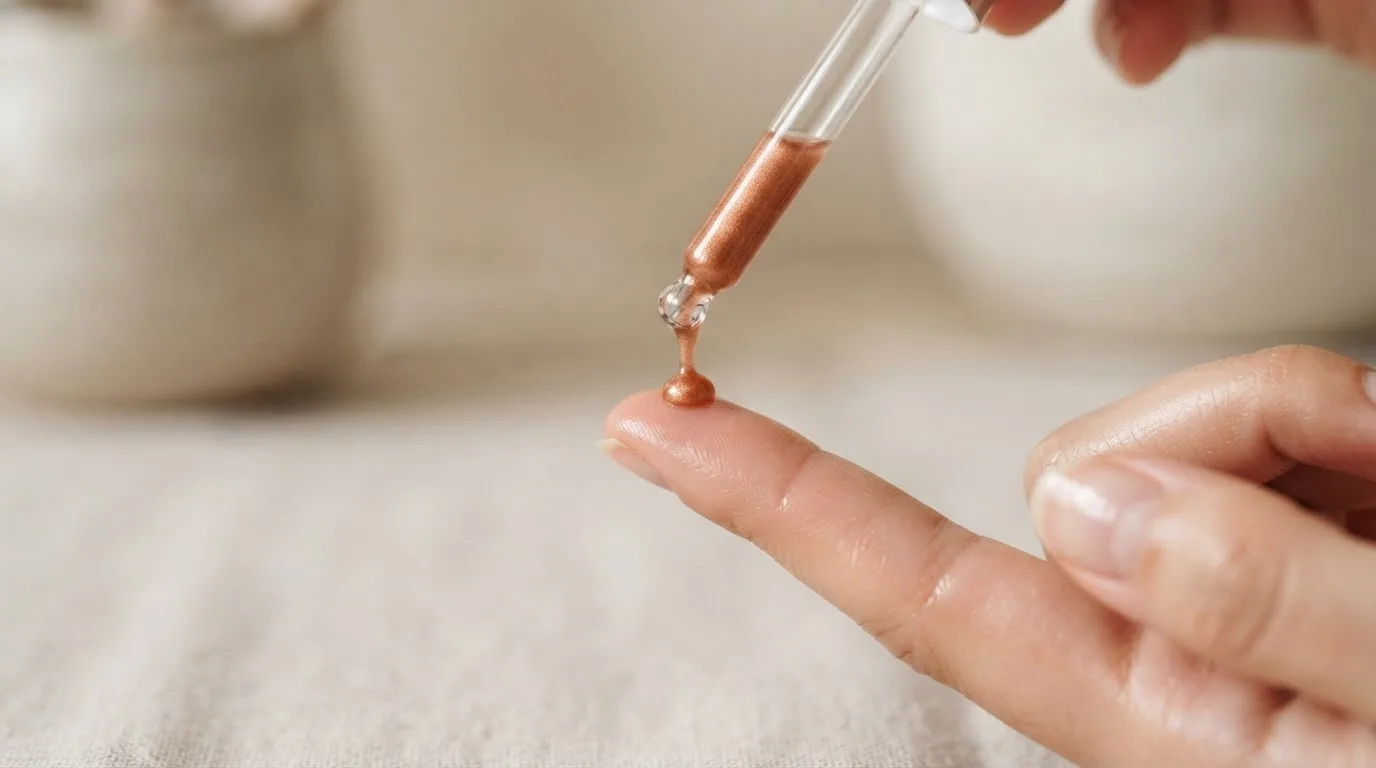
Copper Peptides Skincare: The Regenerative Ingredient
It’s the 1970s, and researchers are studying how wounds heal. They notice something curious. The fluid from a healing wound contains copper ions, and those ions seem to be doing more than just sitting there. Wounds treated with this fluid heal faster. Tissues rebuild stronger. The scientists realize that copper isn’t just a passive trace mineral. It’s an active signal. A message that tells the body, “It’s time to repair.”
That discovery led to the development of GHK-Cu, a small peptide naturally bound to a copper ion. And it changed skincare forever.
Most active ingredients in a routine work by forcing change. They exfoliate, they dry, they irritate cells into behaving differently. Copper peptides do something far more elegant. They communicate. GHK-Cu is a signaling molecule. It speaks directly to skin cells and says, “Rebuild. Repair. Produce more collagen. Strengthen your barrier.” It doesn’t strip or attack. It regenerates.
This makes copper peptides a rare breed in the active ingredient world. They don’t just treat the surface. They work at the cellular level to encourage the skin to heal itself. Think of them as a gentle but persistent coach for the complexion. They support wound healing, reduce inflammation, and help fade the visible signs of aging by encouraging the skin to do what it already knows how to do, only better.
But here’s where it gets tricky. Copper peptides are powerful. They interact with other ingredients in ways that can either boost results or cause irritation. That’s why this guide exists. It walks through exactly what copper peptides are, how they work under the microscope, and how to weave them into a routine without creating conflicts. Readers will learn how to pair them with favorite actives and when to keep them separate.
What Are Copper Peptides (GHK-Cu)?
At their core, copper peptides are tiny protein fragments. Specifically, they are short chains of amino acids called tripeptides. The most famous one is GHK, which stands for glycine-histidine-lysine. Attach a copper ion to that tripeptide, and the result is GHK-Cu. That little complex is the star of the show.
Here’s the fascinating part: GHK-Cu isn’t something scientists invented in a lab. It occurs naturally in the body. Human plasma contains this copper peptide, and it plays a role in wound healing and tissue repair. But here’s the catch — levels decline as people age. By the time someone reaches their sixties, their natural GHK-Cu concentration can be a fraction of what it was in their twenties. That drop matters because the skin’s ability to repair itself slows down right along with it.
The story of copper peptides begins with Dr. Loren Pickart in the 1970s. He was researching how aging affects wound healing when he isolated GHK-Cu from human serum. His work showed that this peptide could stimulate collagen production and attract repair cells to injured tissue. Initially, the focus was on medical applications — helping burns and surgical wounds heal faster. But it didn’t take long for the cosmetic world to take notice. If copper peptides could regenerate damaged skin, why not use them to fight wrinkles and improve texture? That shift from wound care to skincare happened gradually, and now GHK-Cu is a staple in anti-aging formulas.
Copper peptides fit into the broader world of peptides in a unique way. Peptides are everywhere in skincare — signal peptides, carrier peptides, enzyme inhibitor peptides. They all work by sending messages to skin cells. But copper peptides are unique because they carry a metal ion that amplifies their activity. The copper itself is essential for enzymatic reactions that build collagen and elastin. So while many peptides simply tell cells what to do, copper peptides also provide the raw material to get the job done. That dual action is why dermatologists often single them out.
For those curious about how peptides stack up against each other, the peptides skincare guide breaks down the different types and what they actually do for the skin.
How Copper Peptides Work on the Skin
Let’s get into the science, because this is where copper peptides really shine. When a copper peptide like GHK-Cu is applied to the skin, it doesn’t just sit there. It gets to work at a cellular level, and the results are genuinely impressive.
First, GHK-Cu acts as a signal. It tells the fibroblasts — those hardworking cells in the deeper layers of the skin — to ramp up production of collagen and elastin. Think of it as a gentle nudge to the skin’s natural repair machinery. More collagen means firmer, plumper skin. More elastin means better bounce and resilience. It’s like waking up the skin’s internal scaffolding and asking it to rebuild.
But that’s only part of the story. Copper peptides also promote angiogenesis, which is just a fancy way of saying they encourage the formation of new blood vessels. Why does that matter? Better blood flow means better nutrient delivery. Skin cells get more oxygen, more vitamins, more of the raw materials they need to stay healthy and repair damage. It’s like upgrading the skin’s supply chain.
Then there’s inflammation. Copper peptides are known to modulate cytokines — the proteins that drive inflammation. Instead of letting inflammation run wild, GHK-Cu helps keep it in check. That’s crucial because chronic low-grade inflammation is a major contributor to premature aging. By calming things down, copper peptides create an environment where healing can thrive.
And don’t forget the antioxidant side. Copper ions can be tricky — free copper in the skin can actually cause oxidative damage. GHK-Cu chelates those free copper ions, binding them up and preventing them from causing trouble. It’s a built-in safety mechanism. For a deeper look at how antioxidants protect the skin, the complete guide to antioxidant skincare offers more detail.
Research backs all of this up. Clinical studies have shown measurable increases in collagen production after consistent use of copper peptides. Wound healing accelerates too. Dermatologists have observed that copper peptides can speed up recovery after procedures like microneedling or chemical peels. That’s why they often appear in post-procedure serums. The evidence is solid, and it keeps growing.
Now, this compares differently to collagen supplements taken orally. One works through topical signaling, the other through internal building blocks. For those curious about that angle, the science-based guide on collagen supplements for skin breaks it all down.
So copper peptides aren’t just another trendy ingredient. They’re a multitasking powerhouse that supports the skin from the inside out. And that brings us to the real-world results.
Key Benefits: Collagen, Repair, and Firmness
Let’s break down what copper peptides actually do. First up is collagen and elastin synthesis. Think of collagen as the scaffolding that holds the skin up and elastin as the springs that let it bounce back. As people age, both decline. Copper peptides signal the skin to produce more of these structural proteins. The result is skin that feels firmer and looks plumper. It’s not an instant fix. It’s a gradual rebuilding process that dermatologists agree delivers real, measurable change over time.
Then there’s barrier repair. The skin barrier is that thin protective layer keeping moisture in and irritants out. When it’s damaged, water escapes and the skin feels tight, flaky, or reactive. Copper peptides step in to accelerate healing of micro-damage. This means less transepidermal water loss and a calmer complexion. For anyone who has ever struggled with a compromised barrier from over-exfoliation or harsh weather, this is where copper peptides earn their keep. They help the skin recover faster and stay resilient. Research suggests consistent use can visibly improve skin roughness and overall texture.
The third benefit ties it all together: improved firmness and reduced fine lines. This is the payoff. After about twelve weeks of consistent topical use, studies show visible improvements in wrinkle depth and skin density. Fine lines soften. Skin feels tighter. It’s not dramatic overnight change, but a cumulative lift that makes a person look well-rested and healthier. For anyone exploring how to support the skin’s long-term structure, copper peptides offer a scientifically backed path.
For a deeper dive into how the barrier heals itself, the guide on repairing the skin barrier is a helpful resource. And for a broader look at keeping skin youthful over the long haul, the article on skin longevity trends is a great next read.
Copper Peptides vs Retinol: Which Should You Choose?
Let’s put these two heavyweights side by side. Retinol speeds up cell turnover. It pushes fresh cells to the surface faster while sweeping away dull, congested layers. Copper peptides work differently. They send signals to the skin to repair and rebuild. Think of retinol as the accelerator and copper peptides as the architect. One clears the rubble. The other draws up the blueprints for stronger collagen and elastin. Both lead to smoother, firmer skin, but they arrive there through completely separate pathways.
This difference matters when deciding which one to use. Retinol can be demanding. It peels, it stings, it makes the skin sensitive to sunlight. Copper peptides are gentle. They soothe inflammation and support the skin barrier. That makes them a better fit for sensitive skin, rosacea-prone complexions, or anyone whose barrier feels compromised. For those who have tried retinoids and found them too harsh, copper peptides offer a regenerative alternative without the irritation.
Now the question everyone asks: can they be used together? The short answer is yes, but with caution. Some research suggests that copper peptides can break down retinol when applied at the same time. That means the benefits of both are lost. The solution is timing. Use retinol at night. Use copper peptides in the morning. This keeps them in separate parts of the day, so each can work without interference. If the skin feels irritated, try alternating nights. One night retinol, the next night copper peptides. Give the skin a break on the third night with nothing but moisturizer.
Who should lean toward copper peptides? Anyone with sensitive or reactive skin. Those with barrier damage from over-exfoliation or harsh treatments. People who cannot tolerate retinoids at all. Copper peptides also suit mature skin that needs rebuilding more than turnover. For a deeper dive into retinol options, the guide to retinol and retinoids offers more detail. And for those curious about gentler alternatives, the article on bio-retinol skincare covers plant-based options that work well alongside peptides.
How to Use Copper Peptides in Your Routine
Let’s talk about where copper peptides actually belong in a routine. The good news is they’re simple to use. Most copper peptide formulas come as a serum, so they’re applied after cleansing and before moisturizer. Aim for clean, slightly damp skin. A few drops, a gentle press, and that’s it.
But here’s where things get interesting. Copper peptides are powerful, but they’re also picky about their neighbors. They don’t play well with certain active ingredients, especially vitamin C in its pure L-ascorbic acid form. When used at the same time, copper peptides can oxidize and degrade that vitamin C, making both ingredients less effective. The same goes for AHAs and BHAs. Those exfoliating acids can destabilize the peptide structure. So mixing them in the same routine step is a waste of good ingredients.
The fix is simple: separate them by time of day. Use the copper peptide serum in the morning and save vitamin C or exfoliating acids for the evening. Or flip it. Morning or evening both work. What matters is giving each ingredient its own window to do its job without interference. For those unsure about the full layering logic, the guide on the skincare layering order breaks down every step.
One more tip. Copper peptides have a hidden superpower when used in the morning. They support collagen production and help strengthen the skin barrier. Pair that with a good sunscreen, and the result is a solid photoprotection strategy. The peptides help repair damage while the sunscreen prevents new damage. It’s a smart combo. And for those still figuring out a vitamin C routine, the vitamin C skincare guide offers timing and pairing tips.
Keep it consistent. Apply the copper peptide serum once a day, every day. Watch for any signs of irritation when first starting, but generally they’re well tolerated. The skin will thank you for the regenerative boost.
Who Should Use Copper Peptides?
Let’s be honest: not every skincare ingredient is for everyone. Copper peptides are different. They’re one of those rare multitaskers that work well across a wide range of skin types and concerns. For anyone wondering whether they belong in a routine, here’s a breakdown of who gets the most out of them.
The ideal candidate is anyone in their thirties or beyond who wants to support collagen production. As people age, natural collagen output slows down. That’s when fine lines start settling in and skin loses some of its bounce. Copper peptides are excellent here because they signal the skin to repair and rebuild. They don’t force the process like some stronger ingredients. They gently encourage renewal over time. For anyone looking to maintain firmness and prevent deeper wrinkles, these peptides are a smart addition.
Another group that benefits greatly is anyone dealing with barrier damage. Maybe exfoliation was overdone. Maybe the skin feels tight, irritated, or sensitized. Copper peptides are known for their wound healing properties. Research suggests they help repair the skin barrier and calm inflammation. That makes them a solid choice for recovery. For those who have made some common mistakes like overusing acids or retinol, the article on skin barrier repair mistakes offers more insight.
People who cannot tolerate retinol also find a friend in copper peptides. Retinol is powerful but not everyone’s skin can handle it. Redness, peeling, and irritation are real side effects. Copper peptides offer a gentler path to similar benefits. They support collagen, improve texture, and help with firmness without the harsh adjustment period. Dermatologists agree they are well tolerated by most skin types, including sensitive and reactive skin.
Now, who might want to skip them? If someone prefers a very minimal routine with just a cleanser, moisturizer, and sunscreen, copper peptides may feel like an extra step. They work best with consistency over weeks and months. If someone is already using multiple active ingredients like vitamin C, retinol, and acids, they might not want the added complexity of timing. Copper peptides can interact with some strong actives, so the routine would need careful planning. That’s a juggle not everyone wants.
For most people though, copper peptides are a gentle, effective option. They fit naturally into routines focused on aging well and skin health. For those curious about how needs change across different life stages, the guide to skincare by age decade is a helpful resource.
What to Look for in a Copper Peptide Product
So the buzz about copper peptides has been heard and the decision to add one to a routine is made. Smart move. But here’s the catch: not every bottle on the shelf is worth the money. Some are glorified water with a sprinkle of peptide dust. Others are formulated so poorly that the active ingredient never stands a chance. Let’s cut through the noise.
First, flip that bottle over and find the ingredient list. Look for Copper Tripeptide‑1 or GHK‑Cu — those are the same thing, just different names. If it’s buried near the bottom, walk away. The active should appear within the first third of the INCI list. Why? Because ingredients are listed in descending order of concentration. If copper peptide is lurking after preservatives and fragrance, there’s barely any in there. Concentration is rarely disclosed on the label, so this placement is the best clue. (Need a refresher on reading labels? The guide to ingredient lists covers the basics.)
Next, look at the packaging. Copper peptides are divas. They hate light and air. Exposure to either can degrade the molecule before it even touches the skin. That’s why the best products come in opaque, airless pumps or sealed tubes. Avoid anything in a clear glass dropper bottle or a jar that requires dipping fingers into. The goal is regeneration, not oxidation.
Now, a word on formula companions. Copper peptides are powerful, but they don’t play nice with strong acids like glycolic, lactic, or ascorbic acid (vitamin C). Mixing them in the same product can cause the copper to break down or become less effective. That doesn’t mean acids can’t be used in a routine — just keep them in a separate step, ideally at a different time of day. A well‑formulated copper peptide serum should be paired with gentle, supportive ingredients like hyaluronic acid, niacinamide, or ceramides.
Price tags for copper peptide products swing wildly. Budget options exist for under twenty dollars and luxury serums cost triple that. Don’t be fooled by a fancy brand name or a sleek bottle. What matters is the formulation quality: the right concentration, smart packaging, and a stable base. Sometimes a lesser‑known brand nails all three. Sometimes the big names cut corners. Do the homework, and when in doubt, cross‑reference with the skincare ingredients glossary A–Z.
So the checklist is clear: correct ingredient name, top‑third placement, opaque airless packaging, no harsh acids in the same formula. That’s the ticket to a copper peptide product that actually works. But even the best serum won’t deliver results if used wrong.
The Bottom Line
So here’s the real talk about copper peptides. They aren’t a quick fix. They won’t make the skin look dramatically different overnight or even in a week. But they are one of the most intelligent ingredients to add to a routine if the goal is genuine repair and long‑term structural support.
Think of copper peptides as the construction crew for the skin. Retinoids and acids are the demolition team — they exfoliate, accelerate turnover, and clear away old, damaged cells. Copper peptides do the opposite. They send signals deep into the dermis, telling the skin to rebuild collagen, elastin, and other supportive proteins. That means firmer texture, improved elasticity, and a more resilient barrier over time. But it takes patience. Dermatologists agree that consistent daily use for eight to twelve weeks is where the real payoff happens. Miss a day here and there? Fine. But skipping entire weeks? That just resets the clock.
This also means copper peptides are not a replacement for retinol or vitamin C. They play a different role entirely. Retinol accelerates cell turnover and smooths surface texture. Vitamin C protects against environmental damage and brightens. Copper peptides focus on regeneration from within. They complement those powerhouses without competing with them. In fact, for a well‑rounded routine, all three are valuable — just not all at once. That’s where smart rotation comes in. A good place to start is the guide on building the perfect skincare routine, which shows how to layer actives without irritation. And for those already cycling retinoids and acids, the skin cycling guide for actives rotation explains exactly where copper peptides fit into a weekly schedule.
The key word here is consistency over intensity. A high concentration or a complicated application method isn’t necessary. A few drops of a well‑formulated copper peptide serum applied to clean, damp skin every morning or evening does the job. No stinging, no peeling, no purging. Just a slow, steady rebuilding process that rewards those who stick with it.
So where does that leave the reader? Copper peptides are a long‑term investment in skin that holds its shape, repairs itself, and ages gracefully. They are not a flashy ingredient. They are the quiet workhorse behind the scenes. Use them daily, be patient, and let them do what they do best. The results will speak for themselves — eventually.
For anyone whose skin feels thin, a little slack, or just takes forever to heal a scratch or a breakout, this is where copper peptides truly shine. They’re not about surface smoothness. They’re about rebuilding the foundation. Research suggests that consistent use over eight to twelve weeks is what unlocks their full potential. That means applying them daily, morning or night, and letting the compound do its job without expecting overnight miracles. A subtle plumping might be noticed after a few weeks. A better glow after a month. But the real payoff — firmer texture, less visible fine lines, a stronger barrier — comes with patience.
This makes copper peptides an ideal complement to a broader anti-aging strategy. They play nicely with sunscreen, with a gentle cleanser, with a moisturizer that supports barrier health. They don’t compete with retinol; they can be used on alternate nights or in a different routine slot. They fill a gap that many actives leave open. Because most anti-aging ingredients focus on speeding things up. Copper peptides focus on building things up. And building takes time.
So if the routine has been cycling through quick fixes — peels that tighten for a day, masks that plump for an hour — consider this a shift in mindset. Copper peptides are an investment. Not in a product, but in the skin’s own regenerative capacity. Stick with them. Give them the weeks they need. The skin will thank you, not with a sudden transformation, but with a slow, steady return to resilience.
Editorially reviewed by the lumino.skin content team.
This content is for informational purposes only and is not medical advice.
Learn how we review skincare guidance in our methodology.
Last updated: November 24, 2026