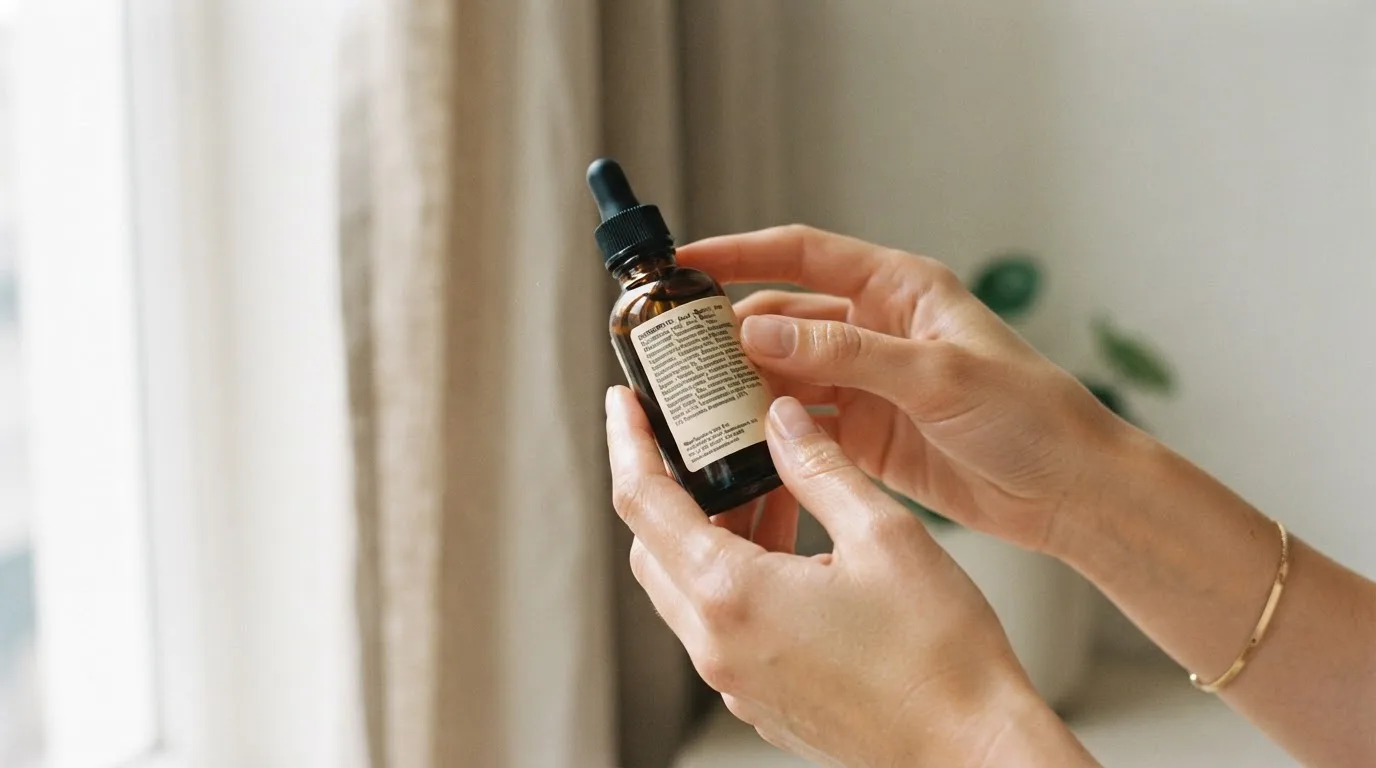
How to Read Skincare Labels: Decode Ingredient Lists
You are standing in the skincare aisle, or maybe you are scrolling through a dozen product pages online. You pick up a bottle. The front screams “clinical strength,” “natural,” or “dermatologist tested.” It sounds perfect. Then you flip it over. Your eyes land on a dense block of tiny text filled with words that look like they belong in a chemistry textbook. Your confidence evaporates.
This is the moment most people give up. They put the product back or rely on the front label to make the decision. And that is exactly what the marketing teams want. Those front-of-pack claims are designed to feel reassuring. They are not always lies, but they are rarely the whole truth. A product can be labeled “natural” and still contain synthetic fragrances that irritate sensitive skin. A “clinical strength” label does not mean the active ingredients are present in effective amounts. The real story of what a product will do for your skin is hidden in the ingredient list.
Learning to read that list changes everything. It turns a passive shopper into an informed one. Guessing stops. The difference between a genuinely effective formulation and one that relies on flashy buzzwords becomes clear. Ingredients that hydrate, repair, or protect become recognizable. The ones that can clog pores, cause dryness, or trigger breakouts become visible. This knowledge gives power. It saves money. It saves skin from products that promise one thing but deliver another.
The good news is that decoding an ingredient list is not as hard as it looks. The ingredients are listed in descending order by concentration. The first few ingredients make up the bulk of the product. The ones at the very end are present in tiny amounts. This simple rule helps separate the stars from the extras. A product that lists a trendy superfood in the last line is not the same as one that puts a proven active like niacinamide or salicylic acid near the top.
Dermatologists agree that the ingredient list is the most honest part of any skincare product. It is regulated. It cannot lie. It can only be misunderstood. This article will teach how to read that list with confidence. Spotting effective formulations, recognizing marketing fluff, and avoiding ingredients that do not serve the skin will become second nature. No more guessing. No more relying on pretty packaging.
Why the Ingredient List Matters More Than the Front Label
Walk into any skincare aisle and the shelves are full of promises. “Clinical strength.” “Dermatologist tested.” “Pro formula.” “Visible results in 7 days.” These phrases sound official. They feel reassuring. But here is the uncomfortable truth: most of those claims are completely unregulated. There is no legal definition for “clinical strength.” No government body checks whether a product labeled “dermatologist tested” actually passed a single study. A brand could slap that phrase on a bottle of glitter water and call it a day.
The front label is marketing. It is designed to make someone feel something. Excitement. Trust. Urgency. And it works. But it tells almost nothing about what is inside the bottle.
That is why the ingredient list matters more. Every skincare product sold legally must include an INCI list. INCI stands for International Nomenclature of Cosmetic Ingredients. It is a standardized system used worldwide. Every ingredient has one official name. No creative rebranding. No hiding behind fancy terms. What is seen is what is there.
And here is the key rule: ingredients are listed in descending order of concentration. The first ingredient makes up the largest percentage of the product. The last ingredients are present in trace amounts. This rule is regulated. Brands cannot rearrange the list to hide cheap fillers or inflate expensive actives. If water is first, the product is mostly water. If an active ingredient like retinol is near the bottom, there is not much of it in there.
This simple ordering gives power. Two serums can be compared side by side to see which one actually contains more of the ingredient that matters. A “hyaluronic acid booster” that lists it after fragrance and preservatives becomes easy to spot. Potentially pore-clogging ingredients can be checked using a resource like our comedogenic ingredients guide. And when an unfamiliar name appears, it can be looked up in our skincare ingredients glossary A-Z.
The front label sells a dream. The ingredient list delivers the facts. And once it is read correctly, the passive shopper becomes someone who knows exactly what they are putting on their skin.
How INCI Works: The Rules Behind the List
INCI lists can look like a foreign language. But they follow a strict set of rules, and once those rules are known, the whole ingredient panel opens up.
INCI stands for International Nomenclature of Cosmetic Ingredients. It is the standardized system used across the globe so that a product made in France and one made in Japan speak the same language. That is why Latin botanical names like Aloe barbadensis leaf juice appear instead of “aloe vera.” It is also why both “Water” and “Aqua” can appear on the same list. They are the same thing. Aqua is simply the Latin word for water, and some brands prefer one over the other. Do not let it cause confusion.
The most important rule is the descending order by concentration. The ingredient present in the highest amount sits first, and the list goes down from there. The first five to seven ingredients typically make up 80 percent or more of the formula. If water, glycerin, and a silicone oil are at the top, that tells the texture and base. The real story is in the middle and bottom.
Here is where it gets tricky. Ingredients present at less than 1 percent can be listed in any order. That means the twentieth ingredient might be at 0.5 percent and the twenty-fifth at 0.1 percent, but they appear arranged by brand preference or alphabetical grouping. The order below 1 percent cannot be assumed to reflect concentration.
Preservatives, fragrances, and colorants always appear near the bottom regardless of their actual percentage. This is because regulations require them to be listed, but they are rarely used above 1 percent. So spotting a preservative like phenoxyethanol near the end is not a cause for alarm. It is doing its job at a safe level.
Active ingredients that deliver results often appear in the top half of the list. Retinol, vitamin C, niacinamide, and peptides need to be present at effective concentrations to work. If a star ingredient is buried below the preservatives, it is likely there in a tiny amount. It might still do something, but dramatic changes should not be expected.
Understanding these rules helps spot when a product is honest and when it is just dressing up. And it changes how that ingredient list is viewed. Ingredient lists also tell about stability. A formula high in water and low in preservatives may spoil faster. That is why checking a product's shelf life matters. Our guide on skincare expiration and storage can help keep active ingredients fresh. And for those curious why some ingredients work better at certain pH levels, the skin pH and acid mantle guide explains that balance.
Finding the Active Ingredients: What to Look For
The ingredient list on the back of a skincare bottle is a legally regulated document that tells exactly what is inside in order of concentration. The first few ingredients make up the bulk of the formula, while the ones at the very end are present in tiny amounts. If the product is expected to actually do something, this is where focus is needed.
Active ingredients are the heavy lifters. Retinol, vitamin C, niacinamide, salicylic acid—these are the ingredients with proven research behind them. But they only work if they are present in the right concentration. Dermatologists agree that an effective concentration of retinol usually falls between 0.1 percent and 1 percent. Niacinamide shines at 2 percent to 5 percent. And vitamin C in its pure form, L-ascorbic acid, needs to be somewhere around 10 percent to 20 percent to make a real difference. If these ingredients appear in the first half of the ingredient list, a clinically relevant dose is likely.
Here is a helpful rule of thumb: look for the preservative line. Preservatives like phenoxyethanol or parabens are typically added at around 1 percent or less. If an active ingredient appears after that line, it is almost certainly at a very low concentration—potentially too low to be effective. That serum claiming to have retinol might only contain a trace amount. That niacinamide toner might be more water than anything else.
So when scanning a label, ignore the fancy marketing on the front. Flip the bottle over. Find the active that matters. If it is in the first third, the product is in good shape. If it is buried near the bottom, consider it a splash of marketing rather than a functional dose. For a deeper dive into how these actives work, check out the complete guide on retinol and retinoids, the deep dive on niacinamide as a multitasker, and the full breakdown of vitamin C in skincare.
Once the active ingredients have been spotted and verified at meaningful levels, there is another layer to the label worth understanding. Not everything in that bottle is there to help the skin. Some ingredients are there to keep the formula stable, others to make it smell nice, and a few are just cheap fillers.
Decoding Preservatives, Fragrance, and Fillers
Preservatives are the unsung heroes of any skincare formula. Without them, a moisturizer would be a breeding ground for bacteria, mold, and yeast within weeks. Preservatives keep the product safe from contamination and stable on the shelf. Dermatologists agree that a well-preserved formula is essential, especially if fingers dip into jars or products are stored in a steamy bathroom. Common preservatives include phenoxyethanol and ethylhexylglycerin. Both are widely considered safe and gentle for most skin types. Then there are parabens. They have been villainized in the past, yet research suggests that the small amounts used in cosmetics are not harmful. Parabens are effective, inexpensive, and have a long safety record. If methylparaben, propylparaben, or butylparaben appear on a label, there is no need to panic. The real issue is not preservatives themselves but the lack of them in many "natural" or "clean" products that spoil quickly and can actually harm the skin barrier. For a deeper dive on barrier health, check out the guide on skin barrier repair mistakes.
Now for fragrance. It appears near the end of the ingredient list because it is used in tiny amounts. But even a drop can trigger reactions. "Parfum" is a catch-all term that can hide dozens of synthetic compounds. Essential oils like lavender, tea tree, or peppermint sound lovely but are also potent allergens and irritants. Just because something is natural does not mean it is gentle. Fragrance is often added to mask the smell of other ingredients or to create a sensory experience. For sensitive skin, eczema, or rosacea, fragrance-free is the safest bet. And for melanin-rich skin, extra caution with certain essential oils that can cause pigmentation issues is warranted. Learn more in the skincare for skin of color guide.
Finally, fillers and texture agents. These ingredients give a product its feel, spreadability, and consistency. Alcohol denat, for example, can make a formula feel lightweight and help ingredients penetrate. But it can also strip the skin's moisture barrier if used high on the list. Silicones like dimethicone create a smooth, silky finish and lock in moisture without clogging pores. They are not evil; they are just texture modifiers. Thickeners such as carbomer or xanthan gum give a gel-like consistency. The key is to distinguish between functional texture agents and cheap fillers that add nothing but volume. A well-formulated product uses fillers sparingly and strategically. A padded product might list water, alcohol, and a thickener as the top three ingredients with active ingredients buried near the bottom.
How to tell the difference? Look at where the preservatives, fragrance, and fillers sit relative to the actives. If the good stuff is above them, the product is likely in good shape. If the fillers dominate the first third of the list, that bottle is mostly fluff.
Ingredient Percentages: What the Label Doesn't Tell You
Ingredient lists are legally required to be honest, but they are also allowed to be vague. The INCI system lists everything in descending order of concentration, from highest to lowest. That sounds straightforward. But it only tells the relative weight of each ingredient, not the exact percentage. A product could have 1 percent of a hero ingredient or 0.1 percent, and the label would look exactly the same. The difference between a formula that transforms skin and one that just feels nice on the face often comes down to that hidden number.
So how to estimate without a magnifying glass and a chemistry degree? Look for the preservatives. Ingredients like phenoxyethanol or parabens are almost always used at 1 percent or less. If an active ingredient appears after a preservative, it is safe to assume its concentration is below that 1 percent threshold. That does not automatically make it useless, but it gives context. Some brands voluntarily disclose exact percentages, especially for actives like vitamin C or niacinamide. Others use star ratings or certification marks (like "20 percent active serum" on the front of the bottle). Those are helpful.
But concentration is not everything. A formula with 10 percent of a cheap, poorly absorbed ingredient can be less effective than one with 2 percent of a stabilized, well-delivered version. Take vitamin C. L-ascorbic acid is the most effective form, but it is unstable and requires a low pH to work. Ascorbyl glucoside is gentler and more stable, but the skin has to convert it first. Same ingredient family, completely different results. The delivery system matters. The pH matters. The form matters.
And here is a secret that can save a lot of money: some ingredients work beautifully at very low concentrations. Peptides often perform their magic at fractions of a percent. Certain antioxidants like resveratrol or ferulic acid are potent enough that tiny amounts make a real difference. Being low on the list does not mean being ineffective. It means the ingredient is powerful enough to earn its spot with less.
The real question is not just how much is in the bottle. It is how well that ingredient can actually work on the skin. So before tossing a product because an active is near the bottom, consider the whole picture: the formula, the delivery, and the science behind it. That is the difference between reading a label and understanding it.
Red Flags: Ingredients to Be Cautious About
Scanning a skincare label can feel like reading a foreign language. But once the red flags are known, the whole process gets much simpler. Start by looking for alcohol high up on the list. Denatured alcohol, SD alcohol, or simply "alcohol" near the top half of ingredients means the formula could be stripping the skin's moisture barrier. These are drying alcohols. They evaporate quickly, giving a temporary matte finish, but over time they can cause irritation, flaking, and even breakouts. That is a problem for anyone trying to build a healthy barrier. For a deeper look at how ingredients affect the skin's protective layer, check out the guide on repairing your skin barrier.
Not all alcohols are enemies. Fatty alcohols like cetyl alcohol, stearyl alcohol, and cetearyl alcohol are actually moisturizing and soothing. They appear in rich creams and lotions. Do not confuse these with the drying kind. A product claiming to hydrate but listing denatured alcohol in the top five? That is a red flag. The claim does not match the formula.
Also watch for known irritants like synthetic fragrances, essential oils, and certain preservatives such as methylisothiazolinone. Research suggests these can trigger contact dermatitis, especially for sensitive skin. If a product says "hypoallergenic," remember that term has no legal definition. Any brand can slap it on a bottle. The same goes for "clean." There is no regulatory body that defines what clean means. It is a marketing word, not a safety guarantee.
Another red flag? Ingredients that do not align with the product's purpose. A lightweight gel moisturizer should not be packed with heavy oils unless pore-clogging trouble is the goal. Learn more about which ingredients can cause breakouts in the comedogenic ingredients guide.
Sometimes a red flag is actually a misunderstood ingredient. For example, some natural oils get a bad reputation for being "pore-clogging" when they are actually beneficial at low concentrations. Context matters. The concentration, the formulation, and the skin type all play a role.
How to Compare Two Products Using Their Labels
Two similar looking products are in hand. Maybe two vitamin C serums or two moisturizers for dry skin. They both promise the same results. One is half the price. How to decide?
Start with the first five ingredients. This is where the real formula lives. Ingredients are listed in descending order by weight. If a product claims to be hydrating but water is followed by a cheap silicone filler and fragrance, that hydrating promise is mostly marketing. The first five ingredients tell what the product actually is. Everything after that is present in smaller amounts.
Next find the key active ingredient. Scan the list for retinol, vitamin C, niacinamide, or whatever the product is supposed to deliver. Note where it sits. An active that appears after the preservative is likely present at a very low concentration. Research suggests that effectiveness drops significantly when actives are buried deep in the list. The star player should be somewhere in the top half.
Now check for unnecessary irritants. Drying alcohols like denatured alcohol can strip the skin barrier. Essential oils like lavender or peppermint can cause sensitivity over time. Fragrance is a common culprit for reactions. If one product contains these and the other does not, the simpler formula is usually the better choice for long term skin health.
Look at the preservative system. This might seem boring but it matters. Parabens are effective and well studied. Phenoxyethanol is common and safe. Products without preservatives often use high concentrations of essential oils or alcohol to prevent microbial growth, which can be harsh. A clean preservative system keeps the formula stable without irritating the skin.
Finally consider the formulation type. A serum delivers active ingredients in a lightweight base that penetrates quickly. A cream adds emollients and occlusives that sit on the skin longer. A toner is mostly water with minimal active content. Comparing a serum to a cream is not a fair fight. They serve different purposes.
Consider two hypothetical moisturizers. Product A lists water, glycerin, squalane, niacinamide, and dimethicone as its first five ingredients. Niacinamide appears early. No fragrance. No drying alcohols. Product B lists water, alcohol denat, fragrance, silicone, and a tiny amount of retinol near the bottom. Product A wins every time. It delivers hydration and a solid active without the irritants.
For a deeper dive into choosing the right moisturizer for a specific skin type, check out the guide on how to choose moisturizer for skin type. And for comparing face oils, the face oil guide for skin type breaks down which oils actually absorb versus just sit on top.
Putting It All Together: A Quick Label-Reading Checklist
Reading a skincare label can feel like decoding a secret language. But once the key points are known, it becomes second nature. This checklist is a shortcut. Save it, screenshot it, or keep it in notes. It will be used every time a product is picked up.
1. Skip the front — read the INCI list.
The front of a bottle is marketing. The back is truth. Flip the product over and find the ingredient list, usually labeled as "Ingredients" in descending order. That is where the real story lives.
2. Check the first 3-5 ingredients for the formula base.
These make up the majority of the product. If water is first, it is a hydrating base. If an oil or silicone is high up, the texture will be richer. This tells instantly if the product suits the skin type. Dry skin can handle oils early on. Oily skin prefers lighter bases like glycerin or aloe.
3. Find the target active and note its position.
Looking for vitamin C, niacinamide, retinol, or hyaluronic acid? Scan the list. If the active is in the top half, it is likely at an effective concentration. If it is near the bottom, it is there in a tiny amount. For sensitive skin, even a small percentage can work. For visible results, aim higher.
4. Scan for red flags.
Watch for drying alcohols like denatured alcohol, SD alcohol, or isopropyl alcohol in the top five. They strip the barrier. Fragrance or essential oils are fine for some, but if the skin reacts easily, skip anything with "parfum" or "linalool" early in the list. The skin will thank you.
5. Consider the formulation type and packaging.
A serum with a great ingredient list will not work if it is in a clear jar. Light, air, and heat degrade antioxidants and retinoids. Look for opaque or airtight packaging. Also check the texture. A gel works for oily skin. A cream suits dry skin. The best formula is the one that will actually be used.
Now grab a product already owned. Go through these five steps. Patterns will start to emerge. Which brands rely on marketing and which ones deliver will become clear. This practice builds label literacy over time. And for building a routine from scratch, the guide on building a skincare routine for beginners can help choose wisely.
The Verdict
The marketing wants a love affair with a story. The pretty bottle, the aspirational name, the promises written in elegant serif font. But the ingredient list has no agenda. It is simply a record. A legal one at that. It tells exactly what is inside, in descending order of concentration. That is the one honest part of the whole package.
Learning to read that list changes everything. It turns skincare from a guessing game into something that can actually be understood. Wondering if a product works stops; knowing why it might begins. Being swayed by a brand's vibe stops; looking for the actual ingredients that matter for the skin begins. That is a superpower. And it is one anyone can develop.
Becoming a cosmetic chemist overnight is not necessary. Start small. Pick one product already owned. Maybe it is the moisturizer or the cleanser. Pull up the ingredient list and run through the checklist from this article. Look for the preservatives that keep it safe. Spot the fragrance if it is there. Notice where the active ingredients land. Surprises may await. A product thought to be full of hero ingredients might have them buried near the bottom. A simple drugstore find might have a surprisingly solid formula.
Over time, this habit builds a quiet confidence. Walking into a store or scrolling through an app, the noise becomes transparent. Knowing what to look for becomes automatic. Buying based on a pretty advertisement or a viral TikTok stops. Buying based on what the skin actually needs begins. That shift is the whole point. Skincare becomes less about hope and more about informed choice.
Dermatologists agree that the ingredient list is the most reliable tool available. It does not exaggerate. It does not use emotional language. It just states the facts. So use it. Let it be the guide. The more practice, the easier it gets. And the better the shelf will look for it. Not because the bottles are pretty, but because every single one of them earns its place.
Editorially reviewed by the lumino.skin content team.
This content is for informational purposes only and is not medical advice.
Learn how we review skincare guidance in our methodology.
Last updated: November 23, 2026